
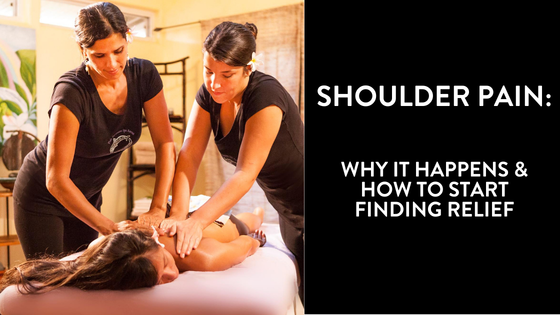
Shoulder pain is one of the most common complaints I hear in my practice. Whether someone is a massage therapist, surfer, paddler, construction worker, or spends long hours at a desk, the shoulder is often where tension, overuse, and stress quietly accumulate—until one day, it doesn’t feel so quiet anymore.
Here on the island of Maui, for a lot of people the shoulders work hard and shoulder injuries occur frequently. And recently, a question came in from a follower asking specifically about shoulder pain. It felt like the perfect moment to explore why shoulder pain happens, how to recognize rotator cuff involvement, and what you can do right now to begin supporting healing.
Common Signs of Shoulder Pain
Shoulder pain doesn’t always show up as a sharp ache right in the joint. Often, it presents in more subtle (and confusing) ways, such as:
- Pain radiating down the arm
- Discomfort when lifting or carrying even light objects
- Pain that changes depending on hand or arm position
- Limited range of motion
- A feeling of weakness or instability
For many people, these symptoms creep in gradually. You adapt, compensate, and push through – until the shoulder starts demanding attention.
Why Shoulder Pain Is So Common
The shoulder is one of the most mobile joints in the body. Mobility is beautiful, but it also means vulnerability.
We ask our shoulders to:
- Stabilize while we reach, lift, paddle, type, and hold tension
- Compensate for poor posture or lack of core engagement
- Support repetitive movements without adequate recovery
Over time, this can create an imbalance between strength and stability – especially in the rotator cuff, a group of small but crucial muscles responsible for keeping the shoulder joint centered and supported.
Understanding the Rotator Cuff (In Simple Terms)
The rotator cuff isn’t one single muscle. It’s a team of muscles working together to stabilize the shoulder while allowing movement. When this system is irritated, strained, or overloaded, pain often follows.
Rotator cuff issues are common in:
- Repetitive overhead movements (surfing, paddling, lifting)
- Desk work with rounded shoulders
- Bodywork practitioners who overuse their arms
- Anyone compensating for old injuries or tension patterns
The key thing to understand is this: rotator cuff pain isn’t just about weakness – it’s about coordination, awareness, and support.
The Wisdom of the Bones
Beyond muscles and joints, there is another layer of intelligence we often look at in Hawaiian Healing: the wisdom of the bones.
From the perspective of the wisdom of the bones, shoulder pain is not only mechanical – it can also reflect what is happening on a metaphysical, energetic, and emotional level. The shoulders are deeply connected to what we are carrying in life.
What are you holding up right now?
Who are you carrying along on your journey?
Are you taking on responsibility for others – emotionally, spiritually, or energetically – beyond your true capacity?
The shoulder is also intimately connected to the heart.
Are you protecting yourself because of past trauma?
Have you found yourself in postures that close the chest or limit movement as a way of guarding your heart?
Sometimes we carry so much, for so long, that the body begins to speak through strain, overuse, or conditions like a frozen shoulder. And sometimes it is not just about overuse, but about holding on – holding on to roles, relationships, or expectations we are not ready to release.
Seen through this lens, shoulder pain may be an invitation to ask deeper questions: What would it mean to bring your heart forward again? What are you doing to care for your own heart, body, and spirit? And what might shift if you allowed yourself to carry less?
A Simple Way to Check for Rotator Cuff Involvement
While a full assessment should always be done by a qualified professional, there are gentle ways to notice patterns in your own body.
Pay attention to:
- Does pain increase when you lift your arm to the side or overhead?
- Is there discomfort when rotating the arm internally or externally?
- Does the shoulder feel unstable, heavy, or “catchy” during movement?
These can be signs that the rotator cuff – and the deeper support system of the shoulder — needs more care, not more force.
For Bodyworkers & Practitioners
If you’re a massage therapist or bodyworker, shoulder pain isn’t just something your clients experience – it’s something many practitioners live with.
Supporting your own shoulders is essential for longevity in this work. That means:
- Refining technique to reduce overuse
- Learning when to use your whole body instead of just your arms
- Receiving regular care, not just giving it
Your body is your primary tool. Treat it with the same respect you offer others.
A Gentle Reminder
This blog is educational, not diagnostic. If shoulder pain is persistent, worsening, or limiting your daily life, working with a healthcare or movement professional is essential.
That said, your body is always communicating. When you slow down enough to listen – to muscles, to bones, to sensation – healing often begins sooner than expected.
Take a moment right now to check in with your shoulders. Notice what they need, not what you think they should be able to do.#
Ready to Learn More? Come Train With Us in Maui.
At Ho’omana Spa in Makawao, on the island of Maui, we host immersive retreats that teach ancient Lomi Lomi wisdom passed down through generations. You’ll learn:
-
Hands-on massage techniques
-
Energy clearing rituals
-
Sacred chant and prayer
-
Cultural protocols and spiritual foundations
You’ll also experience the healing waters, sacred sites, and ohana (family) energy that make this work so transformative.
Next training begins April 6 . Only a few spaces remain.
Click here to learn more at www.LearnLomiLomi.com


